


Just to say: this is a week to really miss Brian Dolan’s MobiHealthNews.1
As everybody in the tech world knows by now, elite smart-ring maker Oura filed to go public this fall, with predicted valuations above $15 billion2. Like all companies aiming to sell shares to the public, Oura Inc.3 submitted an account of its finances to the Securities and Exchange Commission. Here I’m going to use some details revealed in these documents to sketch the company’s vision of the future of wearables.
The Oura ring is not the most important instrument for personal science.4 Nor is it the most popular wearable.5 But it is nonetheless a telling example of how toolmakers think about the epistemic terrain; that is, what we are capable of learning from our new observational capacities and how we’ll go about learning it.
The Oura IPO is a great example to work through because, unlike Apple, Google, Garmin, and Samsung, Oura is 100% a self-tracking company. Its makers were focused on quantified self use cases before the company was even founded. Many of us have met them and talked with them. From the start, they spoke clearly and enthusiastically about how self-tracking can empower us to reason more clearly about our own health. Plus, the ring is amazing. The way it combines signal from different sensors to deliver reliable information about circadian rhythms was truly ahead of its time when it launched, and it has maintained its reputation for accurate measurement. I had a chance to follow along a little bit behind the scenes of the company’s research on ovulatory cycling. They took on this challenge with a seriousness and creativity that impressed me at the time — and still does.
Now they are preparing to go public, with the backing of some of the biggest forces in the investment and healthcare world. (Specifically: Fidelity and Eli Lilly.)
So, what’s their bet? Is this a victory for “citizen science for health?”
What is Oura today?
First, the basics: Oura has approximately five million paying customers. Each of them purchased a smart ring, currently priced from $349 to $499. Since October 2021 these customers have also been offered a monthly subscription to the Oura membership. This subscription allows “access to additional features and functionality.”
The additional features that you gain access to with a membership include daily step count, heart rate, and sleep time. These are among the most useful types of background data for learning about your health, and all are behind the monthly subscription paywall. You can see the table in the footnote for a full list of membership-limited data access, but I think it’s fair to say that Oura has one of the most aggressive members-only policies in the industry today.6 Unsurprisingly, 94% of ring buyers purchase a subscription. And about 85% of the subscribers renew their subscription after a year.
This is a good sign, if you are preparing for an IPO. A common knock against wearables is that people use them until the novelty wears off, and then leave them in a drawer. Oura’s data shows that people keep using it, and they value it enough to pay monthly.
On the other hand, the ring probably set you back $400. Without a membership it is little more than a piece of metal. So, once you buy the ring, you can hardly skimp on membership.
Oura makes four-fifths of its revenue selling rings. Its profit margin on rings is about 47%7 but people don’t buy new rings all the time. Its profit margin on memberships is 89%, and the need for membership renews every month. That’s a better business.
It appears that the recurring app revenue, not ring sales, provides the financial momentum behind the IPO.
But that appearance is misleading.8
An Instrument for Self-Discovery
“A Computer On Your Finger”: Petteri Lahtela and Hannu Kinnunen show their prototype of the Oura ring at QS15, interview by Linda Avey.
When I saw the IPO announcement and the estimate by Bloomberg News that the company’s value could go above $15 billion, my first thought was “what an exit!”
The visionary idea of a wearable ring that could measure activity, temperature, and heart rate was first presented to the Quantified Self community eleven years ago by Petteri Lahtela and Hannu Kinnunen. In 2015, the two Finnish engineers gave a talk called “A Computer On Your Finger” and took questions from Linda Avey and Ernesto Ramirez. At that time, they were just a couple of months away from launching a Kickstarter campaign to prove demand and get them to the first version.
The combination of technical and scientific experience of the founders was impressive. Kinnunen was principal scientist at Polar and led the development of the company’s heart rate and activity algorithms. Lahtela came from mobile-telecom and health IT. Markku Koskela was the physicist on the team, specializing in the collection and analysis of optical signals. All three shared a deep interest in “self-knowledge through numbers.” I did a search on the Quantified Self archives, and noticed that Lahtela registered on the Quantified Self Guide in August 2012, long before Oura was founded.
The talk they gave in 2015 is a classic engineer’s presentation. They focused on the technical challenges and took the value of collecting biometric data mostly for granted. A Quantified Self audience did not need to be convinced that they would like to be able to gather sleep data more easily. Nonetheless, it is interesting to note the use cases that come up during the discussion.
These include:
Increased awareness of physiological readiness for work or competition.
Understanding the effects of jet lag.
Being reminded to eat and sleep at the right times.
Testing everyday hunches against a reliable record; for instance, the effect of a second glass of wine on sleep, or an afternoon cup of coffee.
Predicting cognitive trouble.
Doing collective and collaborative research projects; for instance, students in a class studying the link between sleep and grades.
The overall aim of these engineers was to support individual agency and self-discovery, allowing each of us to make more reasoned decisions in everyday life. Over the past days I’ve spent an inordinate amount of time with Oura’s marketing and financial documents, and I can report that the promise of “self-knowledge through numbers” remains central to Oura’s public identity. As the IPO document puts it: “ŌURA began with a simple but ambitious idea: that we could help people understand their bodies well enough to improve and change the trajectory of their health, not just track it.”9
Having seen countless toolmaker startups come and go, most of them vanishing without a trace, I felt a sense of pride that the Finnish engineers who had shown up at a QS conference with a super ambitious technical idea and the beginnings of a Kickstarter campaign were going to get all the way to a public offering on the US market.
I was especially curious to see how the founders had made out. It was a little disappointing to find that all of them had left the company by 2021, long before the seeds of a strategy that would get them to global scale had borne fruit. The company that is going public is American, not Finnish. In practice, this shift started when Harpreet Rai and David Shuman, two Americans, invested in Oura in 2016, with Rai becoming CEO in 2018. In 2021 Rai was forced out after some corporate in-fighting.10
Strategic continuity from 2016 to today’s IPO plan has come from Shuman, now in the role of Executive Chairman. The board ran a formal search for a new CEO in early 2022 and recruited Tom Hale, previously the president of SurveyMonkey. Hale’s work history suggests he’s gotten enough hard knocks in corporate leadership to know what he’s doing. He’s an operating executive whose expertise is in scaling a company through a big acquisition or IPO. He was the chief product officer of the Austin vacation-rental marketplace HomeAway through its IPO in 2011, and the COO until its sale to Expedia in 2015. He then became president of SurveyMonkey for six years, working on the deal that would have sold it to Zendesk for about $4 billion. Hale started looking for other work as it became clear that the Zendesk shareholders hated the deal. Within days of its collapse he was with Oura. (In the aftermath, SurveyMonkey’s value dropped 60%, while Zendesk, after some deeply confused negotiations, was taken private at a deep discount. Meanwhile Hale joined a company whose investment rounds priced it at about $2.5 billion, and four and a half years later is about to take it public above $15 billion.)
Hale’s most important step after taking the reins was to move into US retail. In April 2023, Oura announced that the rings would be available in 850 Best Buy stores, and that about 50 stores in key markets would have an in-store kiosk where customers could be sized in person. I remember when I saw the Oura kiosk at my local Oakland store; I really had to blink a couple of times to convince myself it was real. Amazon and Target followed, then Costco and Walmart. According to the S-1, retail is now half the hardware business. Ring sales went from 1 million in fiscal 2024 to 3.1 million in the nine months to June 2026.
How does Hale’s success at scaling sales of rings and memberships translate to $15 billion of value? Based on the company’s own numbers, and some standard valuation assumptions, the IPO plan asks us to believe it will sell about 85 million rings over the next ten years and end the decade with about 45 million paying customers.
This seems like a lot. Fitbit, the only real comparator in the dedicated self-tracking market, sold about 100 million devices in its entire history before the Google acquisition, most of them at a fraction of the price and with free access to data. Oura is aiming for more paying members than Fitbit ever had free ones.11
The Epistemic Engine
OK, so what? If Tom Hale and David Shuman and Fidelity and a bunch of limited partners of firms who bought in along the way are going to make money selling shares in Oura to the public in a deal that entails a certain amount of risk — well, isn’t that what markets are for? Speculation supports invention in all kinds of ways, large and small.12 The future is hard to predict. Oura’s execs have global ambitions, and they will end their IPO with a clean corporate setup and a billion dollars of liquidity, and I very much doubt they are out of ideas. Caveat emptor, and best wishes to all.
But that’s not the full story, and the remainder is what interests me the most. If my relatively simple analysis of the financial side of the IPO tells me there’s a gap between the proposed value of the company and the sales data offered to support it, that gap is certainly visible to others. In the run-up to the IPO, the execs will pitch their offering to institutional investors and answer questions. A likely question will be something like: “Accepting, for the moment, that you can sell an unprecedented number of rings and memberships over the next ten years, we see the value of those future sales accounted for in the offering price. Where does future growth come from?”13
And Hale and Shuman have an answer: it is not just cash from future sales of rings and memberships that comprises the asset; it’s what they call the intelligence platform that they’re building with their customers’ data. To quote directly from their prospectus:
“Together our proprietary hardware, software, data, and AI drive a self-reinforcing flywheel that strengthens Oura’s competitive advantage over time. Every day of wear generates richer, longitudinal data and member context, expanding our personalized longitudinal dataset.”
An intelligence platform whose value compounds with scale can be used to support many different kinds of products and features beyond the sale of rings and memberships. The prospectus mentions things like wellness support (for instance “meditation guides”), healthcare integration involving blood pressure and other biometrics, as well as treatment referrals, and population-level discovery services for enterprise and research organizations. (Here you start to see why Eli Lilly came on board this summer.)
So while you buy the ring and pay for the right to see the data it collects, Oura uses your measurements to build both a longitudinal model of your individual physiological responses and aggregates the records of all of its users into evidence for generalizable research, which it can monetize however it likes. Here, Oura enters direct competition with Google and Apple. Welcome to surveillance capitalism; or, and I know it ages me to write this, ALL YOUR BASE ARE BELONG TO US.
I don’t resent that Oura proposes to make money supporting biomedical discovery with aggregate data. There’s a tradeoff, and as individual self-trackers we’ve gained something valuable in return. I appreciate that Oura has succeeded where many other dedicated self-tracking hardware startups have failed, sometimes breaking my heart in the process. The ring works; that was the first triumph. It proved itself to early users in the Quantified Self world, and then crossed the chasm to widespread popular adoption, even while priced substantially higher than competitors. The company grew production and sales to reach millions of users, turned an operating profit, gave a decent exit to early investors, and, if the next months go smoothly, will have a chance to scale another tenfold. Oura brought subtle aspects of biological rhythms to mainstream attention, and developed a research program likely to yield a string of important discoveries.
And yet there remains a difficult passage to negotiate, and the difficulty is evident even in the boastful bureaucratese of the Oura S-1. Even if people like wearing the ring, there is still more work to do, because an intelligence platform, so-called, needs more than sensor measurements to feed it.
A wearable that gives a convenient and well-formatted record of steps, sleep, and heart-rate-derived measures like resting heart rate overnight or heart rate variability, is providing background observations. These function as gentle reminders and support for situational awareness; they also give you the security of knowing that the data is there for you when you want to look deeper, perhaps because you have an urgent question, a symptom or goal, motivating you to think carefully.
But, because these sensor-based measurements are useful mainly in the background, they tend to escape proprietary control. We care about steps, not “Fitbit steps” or “Oura steps.” You can get a decent sleep and step tracker for $100, a third the price of what Oura charges, and no subscription charge.14 The most reliable expert in the QS community on using heart rate variability, Marco Altini, has shown that you can get a good daily measurement with your mobile phone camera as the sensor.
As background observations drift toward commoditization, the more urgent kinds of self-tracking practice remain stubbornly personal. There is no general answer to a question like: “Why did I start breaking out?” Or, “Can I start eating bread again without getting sick?” Or, “Will these exercises improve my tremor?” Or, “Can I avoid scaling back my training, even though I hurt a bit?” Nor is there any definable-in-advance set of things worth tracking. I’ve learned from my own and others’ experience that even a seemingly simple question like “how has my pain level changed over the past weeks” requires tinkering in the context of daily life to get right. Systems of personalized health advice struggle, still, to get anywhere nearly personalized enough.
So wearables companies, even the very best ones, remain generic, their promises of personalization stuck at the level of speculation: “Every day of wear deepens Oura’s understanding of each member, enabling our models to deliver more precise and personalized insights.”15
If only it were as easy to do as it is to say. I’ve noticed, and not only with Oura, that the difficulty in actually delivering on the promise of personalized insights tends to push the promisers into a somewhat aggressive posture. If only people would listen!
Tom Hale, in a November 2025 podcast interview, said this:
One of the reasons healthcare has failed at preventative care is because there’s simply not enough doctors and nurses in the world to educate people about healthcare and the healthy behaviors, and to create the systems of accountability and the motivations and incentives to get them to change. ... The advent of AI, in concert with something like a wearable that you have on your body 24-7, intimate with every change in your physiology, feeding that machine intelligence (and you’ve already got the supercomputer with the screen to display that information to you), which, by the way, has your attention, because you’re staring at it more time than you should — that mechanism is enough to change behaviors at scale.16
Notice what’s missing from this vision: the curiosity and reasoning power of the individual who has already made a choice to buy an Oura ring. That person, the very person whose intense interest in their health has led them to one of the most expensive and sophisticated self-tracking instruments, has been reduced to a mere receiver of information and external influence, the object and target of an administrative mechanism of behavior change.
And it doesn’t even work. At least, I very much doubt it will work. As I read their public statements, Oura envisions AI support living inside their moat, where it will leverage the customer’s data for context and supply actionable advice. This is hard for me to credit. Not just because such a system would encroach on regulated clinical guidance, on one side, and blur into the complex, barely legible terrain of individual inquiry, on the other. These are conventional challenges. The bigger question is how it would work in a world where apps are dissolving. We now have AI support available to us outside the moat. Our robots are increasingly capable of probing and monitoring and copying and reappropriating our records so that we can have more control over them and ask the questions we want.
For a company that has given so much to quantified self practice, the vision Oura is articulating right now has an oddly 20th century industrial-management vibe. But maybe there is a better version here, already implicit in their own system and perhaps already under construction. A wearables company that bridges the gap between the long tail of personal questions and the generic affordances that allow for scaling to tens or hundreds of millions of users may be the one that delivers the best method for finding things out for ourselves. A ring that plays nicely with distributed intelligence, a research program that reveals new use cases and develops new inference workflows, and a membership community that supports learning over compliance: that’s a billion times better than advice.
Show & Tell: Emergency Temps
I don’t flatter myself that the posting day of the QS newsletter is especially important, but you may have a vague sense that this one was late. It was! That’s because I spent the last two weeks in and out of the hospital with a family member with a ruptured appendix. All was fixed in the end, though there were some scary moments. Below is a very brief show & tell I made from one detail of the experience.
What I did
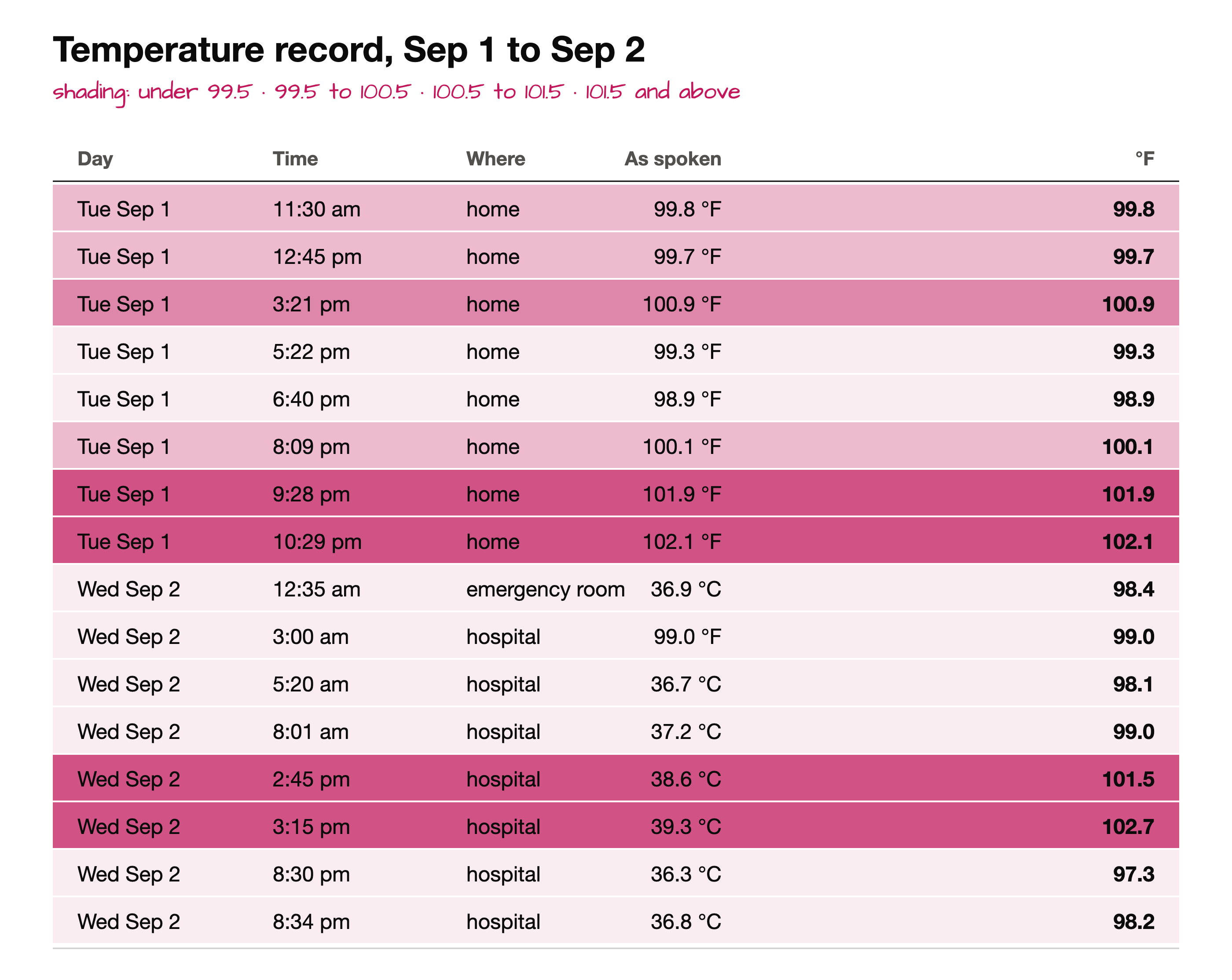
I kept track of the temperature measurements. Body temperature is one of the easiest and most telling measurements for assessing sickness and recovery. In the hospital, it was taken every few hours by a nurse. At home, we measured it whenever we were curious.
There are four reasons why having the record was useful:
Fever is a reliable symptom of infection, so even one out-of-range value can provide an alert in advance of other signs.
A “nothing wrong” signal is reassuring. When other signs, like pain or nausea, send up warning flags, a steady temp within normal range is a dose of instant calm.
Clinical guidance focuses on threshold values, but clinicians with practical experience will look out for trends even if they don’t clearly cross the threshold.
Context affects single measurements: a hot blanket, a warm drink, the rise and fall after a dose of Tylenol, a touchless thermometer you paid too much money for—all create uncertainty. A time series builds confidence you’ve got things right.
Here are some reasons that tracking body temperature was surprisingly tricky.
In the hospital, the series of body temp records isn’t viewable by patients. You have to ask for each temp, and typically you get only the most recent.
Temps are often taken in the middle of the night, when you want to stay quiet, and they aren’t reported aloud unless you ask.
Doing non-clinical measurements using cheap and accurate oral thermometers requires a bit of participation from the person who is sick. That’s not always easy.
I wanted us to have our own record, but I didn’t want any distraction.
How I did it
At home I used an inexpensive drugstore thermometer. In the hospital I quietly asked for the temp every time it was taken, even at night, but I often didn’t record the answer if it was normal and the hour was late.
I recorded the temps by softly repeating what I measured (at home) or was told (by the nurse or CNA) into my mobile phone using the app “Just Press Record”. This app is a one-button affordance on my home screen that begins recording immediately and stores the recordings in a folder. I also spoke the time of the measurement aloud. The iPhone mic is sensitive, so I could speak very quietly. I spoke whatever measurement I saw or heard: at home these temps were in Fahrenheit, at the hospital they were Celsius.
The next time I was on my computer, I asked Claude Code to transcribe the recording, convert all temps to Fahrenheit, and append them to a table where I could review them.
That’s it. No graphs, no charts, no apps except the mobile voice recorder. Simple, although far too complex to have done under these circumstances without AI support for transcribing, converting, and arranging.
What I learned
Why was I glad to have this record?
During a brief discharge that ended in a second hospitalization, the trend gave us confidence to skip going to urgent care (which was the guidance of the advice nurse we reached by phone) and go directly to the ER.
After surgery, a slightly elevated value prompted questions to ask when the doctors rounded in the early morning hours. Having a concrete instance to discuss (“what about this high temp from last night?”) changed the tone of the conversation, eliciting a good discussion about what to look for after discharge. We got to hear an experienced general surgeon speaking with us and three residents about how he would use his experience and knowledge to evaluate the need for another CT scan and further intervention. Now, instead of just “watch for elevated temps and feeling worse,” we had a more nuanced view.
I realize in writing this it may be hard to see the value here if you haven’t yourself been trying to make decisions under the stress and uncertainty of emergent illness. What I’m talking about was not, as the dreadful cliché has it, an “aha moment.”
The benefit was very different. The numbers provided a way to grab onto a relevant fact about what was happening, and to use it to ground a consequential decision and anchor a meaningful conversation.
“Should I go to urgent care or the ER now?”
“How will you assess progress after we leave?”
If you’ve been in the hospital yourself, you’ll know that it is not always easy for patients and doctors to understand and aid each other. We speak different languages. We are subject to different stresses and are accountable on different time scales. For families and patients, time seems to stand still. For the doctors and residents, each room is a stop on a tour that can’t go on too long; extra time in one room squeezes the others. And the nurses and CNAs, wow: in the hospital we were in, they had AI-assisted walkie-talkies hanging around their necks with robotic voices interrupting frequently to demand their attention with requests to “reply or escalate.” To explain how all of these clinicians nonetheless brought so much intelligence and compassion to their job requires a different kind of essay.
For now, and as we leave the hospital, I’ll just note: having specific, relevant measurements to talk through helped us think.
QS News Roundup
Just QS people doing QS things. Please write us a line and let us know what you’re working on — or just say hi.
Eric Daza on “Stats-of-1”
Longtime QS contributor and biostatistician Eric Daza has released a preprint of his statistical primer on digital health N-of-1 studies, which will be published in the upcoming textbook Digital Health Technologies for Drug Development. I was very glad to get this open access preprint. Eric’s work formalizes and extends the practical wisdom he’s gained from doing many of his own self-tracking projects. If you like stats or are developing models, you should definitely look at his work. Here’s my quick summary of four key practical tips:
Consider repeating and alternate conditions rather than leaning too hard on a single before/after.
Think about onset and carryover. Exclude an initial “ramp-up” interval from comparisons and insert sufficient washout time between conditions.
Track plausible time-varying influences—day of week, illness, temperature, workload, prior sleep, meals—and preserve the measurement sequence.
Note that yesterday’s outcome can influence today’s, so treating every observation as independent can exaggerate confidence.
Maggie Delano on tracker threats
Maggie chairs the engineering department at Swarthmore and has done numerous fascinating self-tracking projects. They are lead author of a new IETF document that will shape how the mobile phone will warn when a tracker is following you. Both Apple and Google had separate tracker alerts before joining forces to establish a standard. Now the standard is before the IETF and Maggie’s work on threat models will help guide its development. The narrative scenarios are especially revealing in this document, showing the attack surface these trackers expose.
Martijn Aslander’s Information Autonomy
Martijn Aslander helped organize the very first QS conference in Europe, and continues to be a leader in the free-spirited Dutch community of makers and thinkers about technology. He has a new, highly personal book about regaining agency in digital culture. It is currently available in Dutch and English. See also his reading guide.
KQED on History of the QS Movement
Gabriela Glueck, a radio reporter for San Francisco Bay Area’s flagship public radio station, did a story on the history of the Quantified Self movement, interviewing many of the early participants.
Reprise: Did you miss “Tracking Tics?”
If you haven’t heard my colleague Martijn de Groot talk about his remarkable project tracking one year of involuntary tics, you can listen here.
Fall events
The book launch this fall is giving us a chance to do a series of QS Show & Tell events and author conversations. Most of the events are walk-in, but the two New York events require registration and will likely sell out, so do get yourself registered if you want to come.
San Francisco — Thu Oct 8, 5:30 PM
Book Passage, 1 Ferry Building. In conversation with Kevin Kelly. Free admission, open seating. Event page
New York — Tue Oct 13, 6:30–8:30 PM
QS Show & Tell at Civic Hall, Union Square, hosted by Steve Dean. Tickets $15, or $48 including a copy of the book. Register
New York — Wed Oct 14, doors 6:30 PM, program 7:00–8:30 PM
The Brown Institute for Media Innovation, Pulitzer Hall, Columbia Journalism School, 2950 Broadway. Hosted by the Tow Center for Digital Journalism. In conversation with Nicholas Thompson, followed by Q&A and a signing. Register
Stanford — Tue Oct 20, 3:00–4:00 PM
Stanford eWEAR seminar, “Quantified Self for Health.” Paul G. Allen Building, AllenX 101X, 420 Via Palou. In person and streamed. Register for the stream · Event page
Los Angeles — Wed Nov 4, 6:30 PM
Village Well Books + Coffee, Culver City. “Can We Learn to Live Better?” with June Cohen (The Great Remembering). A ticket includes a copy of the book.
Full list: quantifiedself.com/events
THANK YOU FOR READING
have a great weekend
& drop us a line!

Upon checking, the publication MobiHealthNews still seems to exist; different style though.
The filing states no valuation and no price range; those arrive in a later amendment. The figure in circulation is Bloomberg’s, from anonymous sources, reported August 24, 2026, as “more than $16 billion,” and relayed by TechCrunch: https://techcrunch.com/2026/08/24/oura-is-reportedly-eyeing-a-september-ipo-that-could-value-it-at-more-than-16b/.
The company was registered in Oulu, Finland, in 2013 as JouZen Oy and renamed Oura Health Oy in 2017; the brand is styled ŌURA in its own materials. The entity going public is Oura Inc., a Delaware corporation formed on January 28, 2026, which became the parent of Oura Health Oy in a redomiciliation completed March 31, 2026 (Form S-1, Prospectus Summary; Exhibit 21.1).
There’s no competing with a notebook or spreadsheet app.
The S-1 says global wearable shipments were 212 million units in the twelve months to June 30, 2026, citing IDC. Oura sold 3.6 million: about 2%. The named competitors are Apple, Google (Fitbit), Samsung, Coros, Garmin, and Whoop.
Without a membership, the Oura app shows three daily scores: sleep, readiness, activity. Anything else requires the $5.99-a-month membership, including: sleep stages, total sleep time, heart rate, HRV trends, temp, steps. Whoop gates more: a Whoop membership is $199 to $359 and there is no free tier. Garmin, Fitbit, Apple Watch, and Samsung’s Galaxy Ring all show steps, heart rate, and sleep time with no subscription. (Coaching and analysis are the paid benefits.) Sources: Oura support, https://support.ouraring.com/hc/en-us/articles/360025441594-Export-Share-Your-Oura-Data; Whoop membership pricing, https://support.whoop.com/s/article/Membership-Pricing; checked September 2026.
The 47% hardware margin is implied, not stated. The S-1 reports a blended gross margin of 55% and a membership gross margin of 89% for the nine months ended June 30, 2026, and a revenue mix of $974.0 million hardware and $240.5 million membership (MD&A). It does not report a hardware margin. Backing one out: 55% of $1,214.5 million is $668 million of gross profit; 89% of $240.5 million is $214 million from memberships; the remaining $454 million on $974.0 million of hardware revenue is 46.6%.
References with page numbers. All figures are from Oura Inc.’s Form S-1, filed with the SEC on September 3, 2026 (accession 0001193125-26-381855), https://www.sec.gov/Archives/edgar/data/2133022/000119312526381855/0001193125-26-381855-index.htm. Customers: “approximately 5.0 million Paid Members as of June 30, 2026” (Prospectus Summary); the filing gives no all-time customer count, and reports 3.6 million rings sold in the twelve months to June 30, 2026. Ring prices: “Oura Ring, which is a premium consumer device priced at $349 to $499” (Risk Factors); Oura Ring 5, launched June 4, 2026, carries starting MSRPs of $399 to $499, Ring 4 was $349 to $499, and Ring 3 was $299 to $549 (MD&A); average revenue per ring was $311 for the nine months to June 30, 2026. Membership launch: “launched our recurring membership subscription model in connection with the introduction of the third generation of Oura Ring in October 2021” (Risk Factors). Membership pricing: $5.99 per month or $69.99 per year in the United States; 63% of new members choose the annual plan (MD&A). Membership features: “access to additional features and functionality through Oura App” (MD&A). Conversion: 94% of ring activations convert to paid membership (Prospectus Summary). Retention: twelve-month paid-member retention of approximately 85%, a figure the filing states is inclusive of members who lapse and return (Key Operating Metrics). Margins: the filing reports a blended gross margin of 55% for the nine months to June 30, 2026 and a membership gross margin of 89% (MD&A); it does not state a hardware gross margin, and the 47% figure is implied by those two numbers and the revenue mix (hardware $974.0 million, membership $240.5 million). Revenue mix: hardware 80% and membership 20% of revenue for the nine months to June 30, 2026 (Risk Factors). Valuation: the filing states no valuation or price range; the “above $16 billion” figure is Bloomberg’s, from anonymous sources, reported August 24, 2026, and relayed by TechCrunch, https://techcrunch.com/2026/08/24/oura-is-reportedly-eyeing-a-september-ipo-that-could-value-it-at-more-than-16b/.
Oura Form S-1, Prospectus Summary, “Our Mission & Founding.” Also: “Understand your body. Own your health.” And: “Oura gives you insights unique to your body, so every day adds up to a longer, healthier life.” (Homepage, live September 2026, https://ouraring.com/) Women’s health partner post, February 4, 2026, https://ouraring.com/blog/oura-womens-health-partner-platforms/ “You know your body best; Oura helps you listen.” And: “empowering individuals to make informed health decisions and deepen their self-understanding” Member stories post, September 24, 2025, https://ouraring.com/blog/oura-health-member-stories/ “Track everything. Use the data at your fingertips—log how you feel, compare it, act on it… Be your own advocate, because no one will fight harder for you than you.” “Give Us the Finger” brand campaign, May 28, 2025, https://ouraring.com/blog/give-us-the-finger-brand-campaign/ “Oura empowers members to make smarter, sustainable decisions each and every day.”
I knew Rai slightly; he had brought Oura into sponsoring a QS conference, which I appreciated, and I remember him seeming a bit stressed out around the time he departed, but he never shared anything with me about Oura management.
For deeply curious and/or skeptical readers, here is a web version of the model I used to explore the assumptions in the S-1: https://quantifiedself.com/studio/oura-valuation/. I had fun creating this with my robots, assigning the task to three agents with identities I defined as “Haas Business School Professor” (responsible for drafting the assignment and providing feedback), “Student-Modeler” (responsible for building the model and asking clarifying “naive” questions), and “TA” (responsible for intermediate QA and build feedback). I then did an agent-assisted “anti-pedantry review” where I tried to purge the model of excessive complexity and reduce the over-concern with edge cases that typifies the agentic work style. You can change the numbers and think about what factors are important. You can also just point your agents at my model and the original S-1 source document and ask them for a version that suits your needs better.
I write this edition of the Quantified Self newsletter from a hot desk at my local Berkeley WeWork, for which I pay a discounted rate thanks to the losses endured by SoftBank, a footnote I add just because I couldn’t resist sending the robots out on a tangent mission to retrieve this: “SoftBank put more than $10 billion into WeWork and wrote the stake down to zero after the November 2023 bankruptcy; WeWork emerged from Chapter 11 in June 2024 with more than 170 locations closed and its rent bill cut by over $800 million a year.” (CNBC, June 11, 2024, https://www.cnbc.com/2024/06/11/wework-announces-emergence-from-bankruptcy-names-john-santora-ceo-chapter-11.html). And when I asked for references for speculative losses fostering innovation, they offered me these citations: “On speculation as the financing mechanism of technological revolutions, the standard reference is Carlota Perez, Technological Revolutions and Financial Capital: The Dynamics of Bubbles and Golden Ages (Edward Elgar, 2002); see also William H. Janeway, Doing Capitalism in the Innovation Economy (Cambridge University Press, 2012).” Just to be clear, I haven’t read them.
So this was my perhaps innocent way of thinking about it: the value of the company at the IPO should be the discounted value of the cash the company is expected to earn in the future. If a conventional model accounts for most of a $15 billion price, then buyers at the IPO are paying full price for these future profits. But there’s risk, too, and that risk is only worth taking if there’s a prospect of higher returns, which can only come from faster growth or a new line of business.
That’s from mainstream companies like Google and Garmin. I won’t bother going into the “no brand” Chinese wearables out there, those cheap devices that proliferate endlessly under the surface of the market like little gremlins in an animated cartoon inspired by Clayton Christensen. Maybe it would be fun to see some examples? OK, what the hell, why not: Xiaomi Smart Band 9 Active ($32.99, https://www.mi.com/global/product/xiaomi-smart-band-9-active/), Amazfit Bip 6 ($79.99, https://us.amazfit.com/products/bip-6), and COLMI R06 smart ring ($39.98, https://colmi.info/products/colmi-r06-smart-ring). Xiaomi’s Smart Band 10, the brand-name version of the same thing, is about $52. (Note that I did zero checking of how these really work.)
Form S-1, Business, “Our Business,” p. 118. https://www.sec.gov/Archives/edgar/data/2133022/000119312526381855/d119865ds1.htm
Very lightly edited.
Great piece, Gary. A fascinating read, thank you.
The Oura ring is an impressive device, but the convenient form factor comes with trade-offs, and the company may have made claims that overstate its accuracy (see the ongoing class action lawsuit). Doesn't mean it can't be useful, but it's important to understand the limitations of any device before you over-interpret the data.
Some health insurance plans now include a complimentary Oura ring, so maybe that's where they see their future growth. That might also explain the "industrial-management vibe"...