
Are Wearables Worth It?
Relentless optimization marketing of wearables hides their value.

Hi, Gary Wolf here.
This week, some reflections on the (always simmering) wearables pushback.
Also: a short poll on two subjects, and tuba.
The NY Times on the Dubious Value of Wearables
If you have any reason to add detail to your mental model of how self-tracking with wearables is likely to be understood by a well-intentioned physician, this week’s piece from the NY Times is an excellent primary source: The Silicon Valley Health Trend Making Doctors Nervous: Is more data about your body actually good for you?
Here, Times opinion writer David Wallace-Wells talks to Dr. Rachael Bedard, a primary care physician who has tangled with tech promoters online about the potential value of tracking biometrics without clear clinical value. The standard icons of self-optimization (Peter Attia, Joe Rogan, Bryan Johnson, Casey Means) appear as stand-ins for the practices of self-tracking generally.
We learn about the potential anxiety that comes from aimlessly sorting through self-collected data looking for problems, the risk of false positives and overdiagnosis, and the clueless sense of entitlement that leads techno-solutionists to propose universal benefits from tools that don’t address the fundamental barriers to population-level improvements in health.
Happy as I am to see some of the simultaneously boring and boastful claims of MAHA influencers brought into contact with common-sense critique, it’s nonetheless baffling that this seemingly well-informed conversation completely ignores the challenges of real people wrestling with health questions almost no patient or clinician can address without self-collected data.
Finicky details of dose and symptom management; coping with complex chronic conditions while balancing the demands of daily life; making sound judgments about tradeoffs between health, money, diet, family, and work: self-observation is indispensable for reasoning about these kinds of things. Everybody has questions for which no off-the-shelf answer exists. What are we supposed to do: not reason about them?
The absence of any acknowledgment or evidence of sympathy with the reality of decision making under uncertainty that nearly all people experience at some point was glaring in this discussion.
My Fitbit doesn’t tell me anything I don’t know
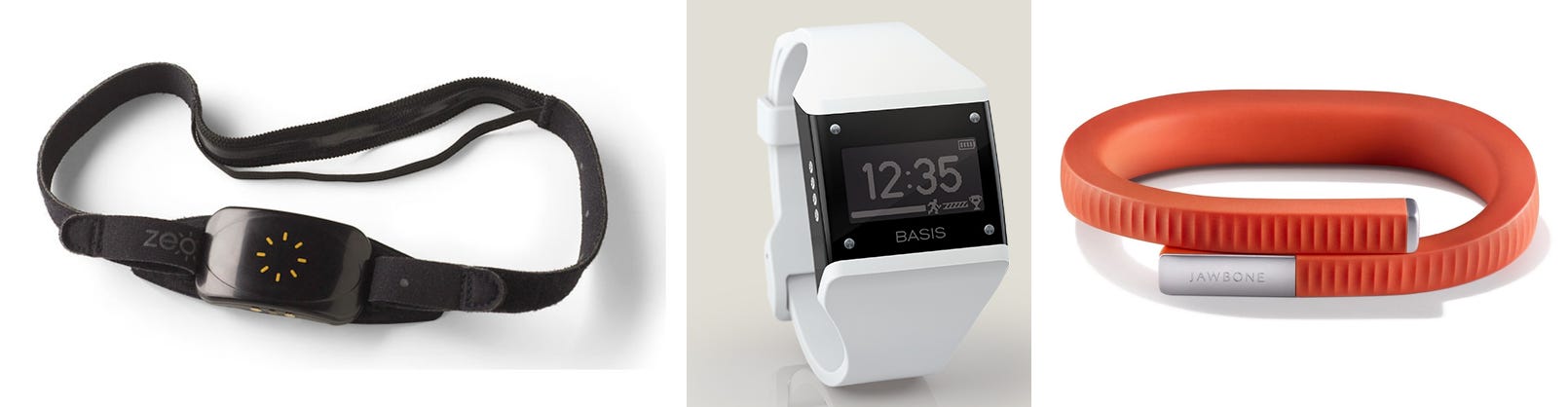
Much of the dismissive criticism of self-tracking is directed at popular wearables. And there’s a genuine issue here. A complaint I hear often from people who have dipped a toe into self-research: I have lots of data from my Fitbit/Oura ring/Apple Watch, but I’m not really learning anything I don’t already know.
This is not usually a complaint about data quality. The data is good (enough). The problem is that these devices arrive with the meaning already packaged in. They’re designed to answer a question you may or may not have. If you do already care a lot about what they measure, they work as intended. If you don’t care that much, you wonder: So what?
Uncertainty about the value of step tracking and sleep tracking hasn’t stopped people from buying. (I just looked up the global sales number; it’s hundreds of millions per year.) What’s the point of all these step counts?
I often try to find out if people can get a bit more specific in offering an off-the-cuff explanation of why they track their steps. Mostly, they can’t. Sometimes they say that it’s “motivating.” It seems that many people, including me, my 89-year-old mom, and people I randomly survey in the grocery store line, “just like looking at it.”
I respect this answer. Step tracking is allowed to be fun and interesting for no good reason; maybe it’s like sticking your hand out the car window to feel the rain, or learning the names of plants. Ask me to justify why I do those things, and I’m going to be just as vague. (Although if you press me further, I may try to convince you that humans have what Piotr Wozniak likes to call a learn drive.)
But there’s another reason, aside from basic curiosity, that wearable data is useful even if it doesn’t provide very much insight in its normal app-served form. Wearables give you background data.
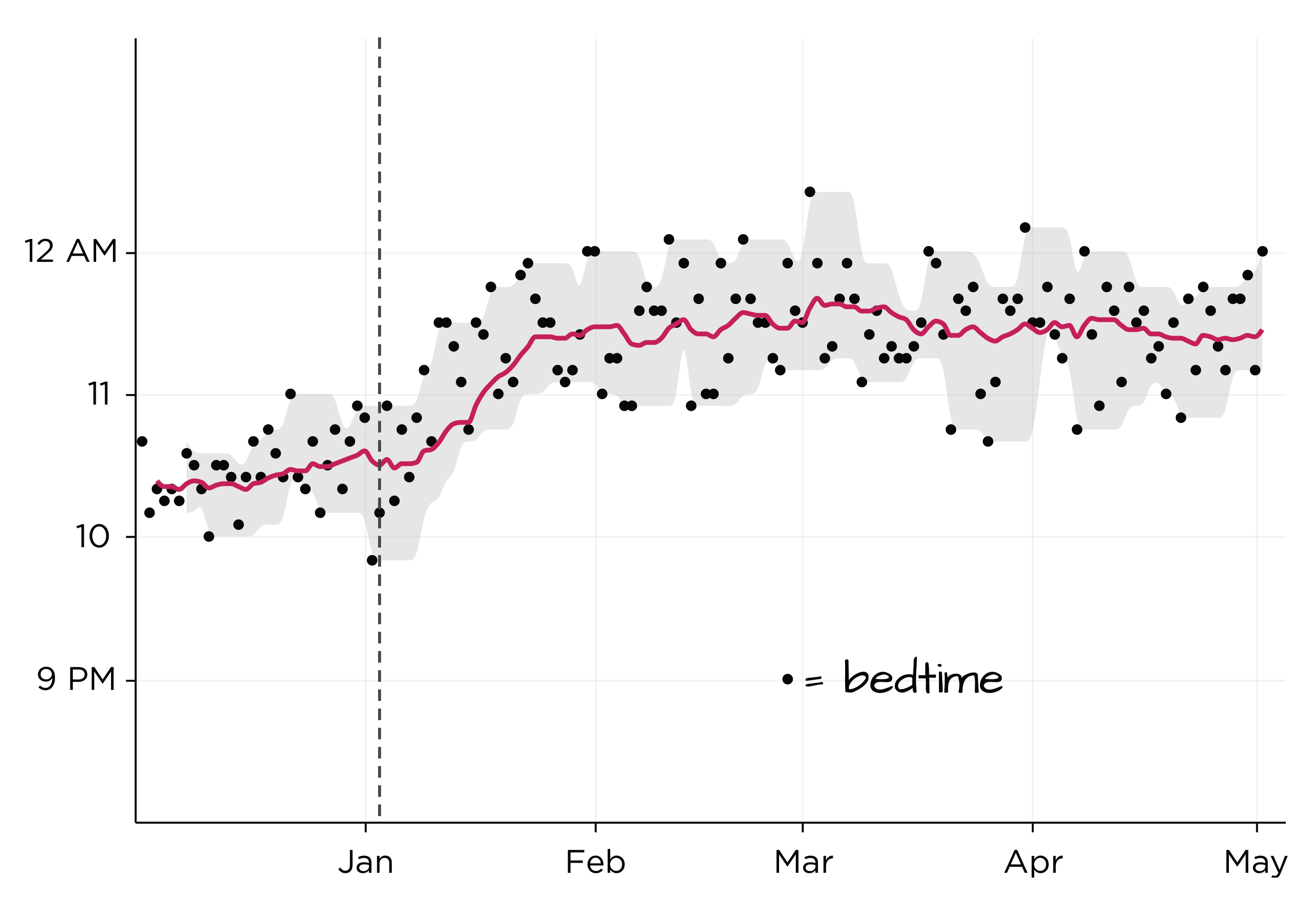
The illustration above shows how data collected from a wearable sleep tracker can be used to assess the effects of a change in medication on sleep timing.1 Dots are nightly bedtimes. The line is a two-week average, and the grey band shows the weekly range. Note that while the average bedtime shifts upward by a bit less than an hour, the variation in bedtimes widens. This means: later, but also less regular. The dotted line is the medication change.
I’ve presented this example with an extra strong signal so the method is clear. Your mileage will vary. But questions about sleep and side effects of medication are very common, and having good background data can help you answer them. (Perhaps you’ll see no change at all. Remember: negative results are useful, too.)
The Undramatic Virtues of Background Data
Background data is a concept that emerged from workshops and discussions in the QS community in the years just before the pandemic. At that time, there was a (slight, in retrospect) surge of interest in very small-scale studies and N-of-1 methods among clinical and academic healthcare researchers.2 This interest was welcome, but at the same time there was some confusion about how the practices of disciplinary research mapped onto what people were doing at home in everyday life. After going around in circles quite a bit (including during a phenomenally mixed-up session at an AcademyHealth Annual Research Meeting in Seattle that Martijn de Groot and I tried to lead), we finally got it through our own heads that personal science has some squarely distinct features, and it was only going to make trouble if we kept trying to hammer it into the round hole of industrial-scale healthcare.
One of the most important features of personal science is that it seeks highly specific and immediately useful personal insights rather than general causal explanations. So while biomedicine, as it hunts for causes, speaks of dependent and independent variables, even successful personal science projects may never assert a confident causal claim. Even where some useful insights about cause are obtained, it’s very rare for these insights to reduce to the kind of weighted analysis of variables seen in social science, laboratory experiments, or clinical trials.
No, “dependent and independent variables” won’t do.
And yet, there is something in personal science that rhymes with dependent and independent. When we try to understand something using our own data, not all of the data we gather plays the same role. Some of it represents directly the thing that we care about most. If we care about stomach aches and we track pain and bloating, then our stomach ache incident records are the most important ones to maintain. We want to have a tracking protocol that we know we can sustain for long enough so that the signal comes through. And we want to carefully think about what counts as a stomach ache so we can rely on the quality of our records.
We’ll also be trying to explain our stomach aches. If they started to get worse at a certain time, we’ll ask what else was going on at that time. And our self-collected data can be useful there too, in a different way. Steps, sleep, heart rate, and glucose values from one or more wearables can tell us something about the context or the background of our stomach aches.
I call this data background data because it’s helping to set the frame; and, if something goes wrong with it, or we have some doubts about its relevance, we can often find additional clues elsewhere.
The relation between foreground and background observations is especially interesting when you’re surprised; for instance, if you are unusually tired but you show consistent sleep. Why? The answer might turn out to be important.
Relentless optimization marketing of wearables hides their value.
I often flinch at the relentless optimization marketing of step trackers and sleep trackers because I think it’s misleading about what they’re good for. No, they won’t cure your sleep or make you fit. But you may really appreciate some background perspective when you want (or urgently need) to think carefully about something in the foreground.
Machine Readable Wishes

Ian Forrester, founder of QS-Manchester back in the day, gave a fascinating talk a couple of weeks ago at EMF Camp on machine-readable wishes: applying the logic of automation rules to the question of what should happen to your personal data after you die. Ian’s talk made me think about my personal archives in a different way. He makes the case that a personal archive should contain executable instructions and provides an open-source framework to help you do this without entangling yourself even further in rent-seeking cloud services.
In case you missed it
The first episode of the Quantified Self podcast went out last week: How to Teach Personal Science, a half-hour conversation with Sara Riggare, Thomas Blomseth Christiansen, and Martijn de Groot about what they have learned putting hundreds of students through the whole question-to-report cycle — sometimes in as little as three days.
Help me make this newsletter better
Any feedback is welcome, but I’m curious this week about two things.
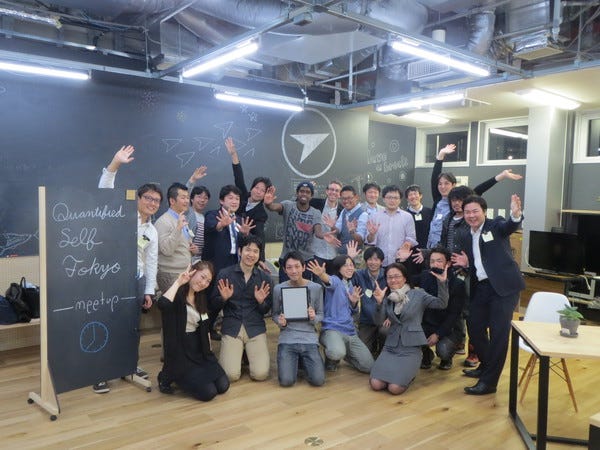
Would you like to come to a local meeting? The release of the book may offer a chance to organize some QS Show & Tell meetups in cities around the world. Use the survey to tell me if this interests you, and, if so, where you are in the world.
Ravi Karkar, who teaches at UMass Amherst, suggested a channel for academic news/opportunities like conferences, workshops, teaching opportunities, and publications. Should we start a subsection of the Quantified Self Substack for this? (Subsections allow readers to opt out while still subscribing to the main channel.)
The survey button makes it quick to answer.
PS… tuba
I played enough baritone horn as a teenager to have a lifelong love for the kinds of instruments that make you beg for a ride to school because otherwise your arm will fall off. At the Obama Center opening a few months ago, Damon Bryson, aka Tuba Gooding Jr., showed the world how it’s done. The whole performance is online but I cued it up to the part I’ve played a dozen times. Come for the low brass, stay for the hope.
That’s it for this week.
I hope you like this so far. Reply or leave a comment below.
Simulated data: no HIPAAs were harmed in the development of this chart.
For instance: Sunita Vohra, “N-of-1 Trials to Enhance Patient Outcomes: Identifying Effective Therapies and Reducing Harms, One Patient at a Time,” Journal of Clinical Epidemiology 76 (2016): 6–8, https://doi.org/10.1016/j.jclinepi.2016.03.028; Sunita Vohra et al., “CONSORT Extension for Reporting N-of-1 Trials (CENT) 2015 Statement,” Journal of Clinical Epidemiology 76 (2016): 9–17, https://doi.org/10.1016/j.jclinepi.2015.05.004; Jiang Li et al., “Reporting Quality of N-of-1 Trials Published between 1985 and 2013: A Systematic Review,” Journal of Clinical Epidemiology 76 (2016): 57–64, https://doi.org/10.1016/j.jclinepi.2015.11.016; R. D. Mirza et al., “The History and Development of N-of-1 Trials,” Journal of the Royal Society of Medicine 110, no. 8 (2017): 330–40, https://doi.org/10.1177/0141076817721131; Nicholas J. Schork and Laura H. Goetz, “Single-Subject Studies in Translational Nutrition Research,” Annual Review of Nutrition 37, no. 1 (2017): 395–422, https://doi.org/10.1146/annurev-nutr-071816-064717.
Nice article. My experience matched what you wrote about wearables: The data from my Apple Watch mostly confirmed things I already suspected rather than revealing anything surprising. I still found the analysis fun to do, and one result was gratifying to see laid out in graphical form: my resting heart rate dropped steadily after I began my exercise regimen.
I also took this on as a way to teach myself Claude Code, and in that aspect, it was a success. Writing all those R scripts from scratch would have taken me far longer if I had to do them without any assistance from AI. My write-up is here: https://www.self-experiments.org/five-years-of-exercise-tracked/
Excellent summary, as always. The world missed your regular writing while you finished your book!
One additional underrated benefit of self-tracking is simply _attention_. It's not about the steps _per se_, but rather the side effects that come from recognizing exercise/movement as a thing.